Community Building Through Skool:
Building a thriving community has become a top priority for teachers, leaders, and entrepreneurs looking to expand their reach and create accountability among members.
Many have turned to Skool as their platform of choice, drawn by promises of streamlined community management and monetization opportunities. However, the reality of running a Skool community often falls short of expectations, with significant limitations in automation, excessive direct messages, and questionable business viability that deserve closer examination.
The appeal of creating a digital school or neighborhood where members can learn, connect, and support each other is undeniable. Teachers transitioning from traditional high school settings and business leaders alike see community building as a way to empower their audience while creating new revenue streams. Yet the decision between free and paid models, the platform itself, and the actual sustainability of membership-based businesses raises critical questions.
This article examines whether Skool truly delivers on its promises or if community builders are better served by alternative approaches. From the platform’s functional gaps compared to free options to the broken economics of membership sites in an AI-driven world, understanding these challenges helps leaders make informed decisions about where to invest their time and resources.
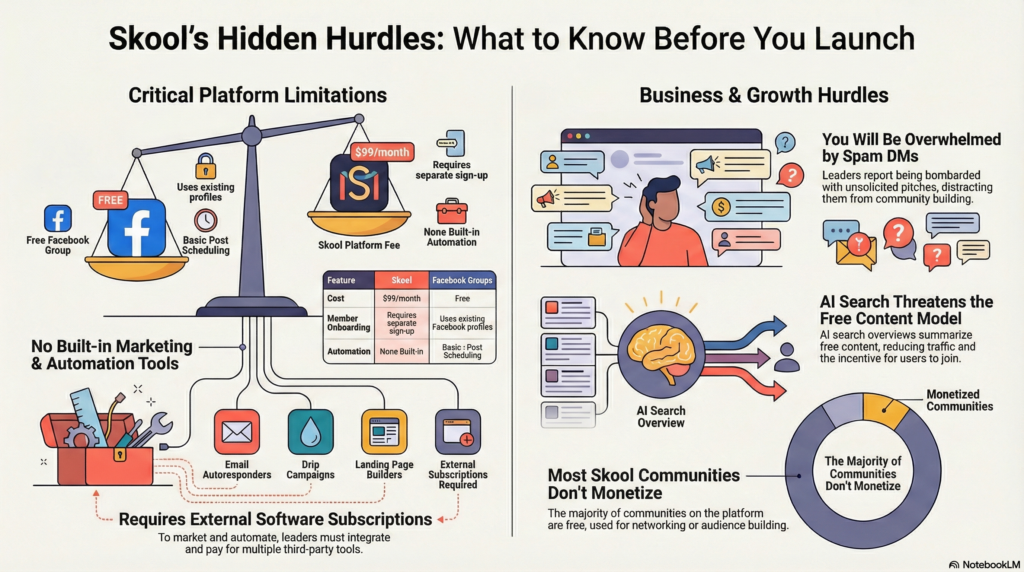
Skool Isn’t Really Better Than a Facebook Group (Free Courses)
Creative professionals should consider leveraging Facebook Groups for their free course sales funnels. They come with a plethora of features at no additional cost. Skool costs a monthly fee per community, which is unlikely to be sustainable for those not making money off their members.
Discussion threads, post scheduling, and member management tools already exist in Facebook Groups. These features help in hosting free educational content and successfully building engagement.
Key comparison points:
| Feature | Facebook Groups | Skool |
|---|---|---|
| Cost | Free | $9* to $99/month |
| Member access | Free | Free or paid |
| Learning features | Basic | Structured |
| Community tools | Standard | Gamification |
*10% transaction fee
Skool’s curriculum structure and gamification are better than Facebook’s. Even so, these benefits, when no money changes hands, don’t justify the platform cost. Free courses with pinned posts, units, and guides allow content organization in a Facebook Group
Points and levels system for participation promotion in Skool. Facebook uses engagement metrics, reactions and comments like standard metrics. The two approaches are more or less interchangeable to build active communities around free content.
With a bigger user base, people do not need to create accounts on Facebook. All users already have access through their profiles. The need for separate sign-ups at Skool presents an extra hurdle.
Skool’s investment is understandable for monetized courses. Facebook Groups provide the functionality necessary for free educational material without high platform fees cutting into your business costs.
You Will Be Semi-destroyed by DM (Direct Messages) and Email Pitches
When someone kicks off a Skool community, they realize something else right away. I get bombarded in my inbox with DMs and email pitches from people selling services, tools and partnerships.
We get these messages every day, even every hour. Many people offer you essential growth strategies or exclusive opportunities that are too good to miss.
Common pitch categories include:
- Community growth services
- Content creation assistance
- Marketing automation tools
- Course development support
- Partnership proposals
- Speaking opportunities
The loudness may distract teachers and other community members wanting to stay on message about engagement with members. Every message takes time for reading, thinking, replying, or deleting it.
Certain pitches may appear to be custom when in fact they are templated. Some get quick benefits in sign-ups or cash in. The sentence written is a good-one and requires no change.
Managing the influx requires:
- Setting specific times to check messages
- Creating email filters and rules
- Using auto-responses for common inquiries
- Establishing clear boundaries about response times
The ongoing barrage of pitches can deter from core community building activities. More often than not the Leader spends more time managing unsolicited outreach than teaching and supporting their members
A COMPLETE STEP-BY-STEP CHEATSHEET
TO CREATING, LAUNCHING & GROWING A SUCCESSFUL MEMBERSHIP WEBSITE

Whether they’ve built a community with 100 members or 14 million, they report similar experiences. Once the community goes live, pitches start almost instantly as the member count increases.
There Are No Automations or Landing Page Building Functionality
Skool does not include any built-in automation and landing page builders. The platform emphasizes its focus on community engagement and course delivery in lieu of marketing automation features.
Skool does not allow community leaders to create email sequences, automated welcome messages, or drip campaigns. This integration with email marketing apps or third-party tools is required by these functions.
Missing automation features include:
- Email autoresponders
- Triggered message sequences
- Automated member tagging
- Scheduled content releases
- Custom workflow builders
The platform does not have its own landing page creation tool. If users want to create sales pages or lead capture forms, they will have to use outside services. This implies that community owners must handle various resources for their marketing work.
There are ways that are manual. Using external scheduling tools or by manually posting, admins can post scheduled content. They can send bulk messages to members with the inbuilt communication features of the platform.
What Skool does provide:
- Manual member communication
- Basic posting capabilities
- Course content organization
- Community discussion spaces
When these features are missing, it impacts how leaders establish and grow their communities. People who depend on all-in-one platforms should become accustomed to process adjustments and keep multiple software subscriptions for marketing.
Are You Really Building School, Not Your Business?
When launching a Skool community, many community leaders face a crucial question. They need to figure out if they’re creating an education space or just repackaging a business.
Key indicators of a true school-focused approach:
- Content emphasizes teaching over selling
- Members receive consistent accountability and support
- Teachers prioritize student progress over revenue
- The community stream shows active learning discussions
A leader who constructs a school provides users with opportunities to learn and grow. They create clear boundaries that keep the community in charge, not the law. The teachers in these spaces focus on educating students first.
Communities powered by business differ drastically. All content creation turns into a sales channel. Each teaching initiative is connected to a good or service. Consumers are directed towards buying things through “email” letters.
| School-First Community | Business-First Community |
|---|---|
| Free foundational content | Paywalled basic information |
| Teacher accountability to students | Focus on conversion metrics |
| Open support channels | Limited access to leaders |
| Education-based rules | Sales-protection policies |
The difference is significant for those who want to create a legit teaching space High school teachers never restrict students for not buying books. They have consistent criteria and create opportunities for every learner.

Leadership needs to thoroughly analyze their community. Are they encouraging the learning community? Customer acquisition or customer education, which do you think this sign-up process is likely to emphasize? The foundation of what they’ve built is behind these questions.
The Whole Membership Business Model of Free, Semi-Broken in the World of AI Overviews?
The way people access information online is changing due to AI-powered search overviews. Users now get to see a complete summary generated by AI in search results. These shifts led to a decline in the number of clicks on websites that enjoyed high organic traffic.
Membership communities that are based on free content face a problem. In the classic approach, in order to garner users’ interest, one offered something valuable for free and then converted a percentage of them into paying members. AI overviews no longer require users to visit the platform and can extract that free content instead.
Key impacts on membership platforms:
- Free content gets summarized by AI without attribution or traffic
- Users receive answers without joining communities
- The top-of-funnel strategy loses effectiveness
- Community leaders see reduced discovery through search
Tools like Skool and other community-building tools rely only on visibility to grow their user base. When artificial intelligence provides instant answers, users no longer need to join the community to learn about something basic. In the current scenario, we see leaders who used to attract members with content that educated them now find themselves competing with AI summaries of their own work.
The model is not totally broken but does need fixing. To counter any ill-effects of AI, communities should highlight what AI cannot replicate: direct interaction with teachers and leaders, accountability structures, peer connections, and exclusive advanced content. The value is no longer about finding information but connecting with people and personalisation.
Membership enterprises must revamp their content architecture in this climate. A once passage is now devoured without transmutation.
Most Skool Communities Don’t Monetize
Most Communities on Skool are free spaces, not paid memberships – with rare exceptions. Many community leaders choose to build their communities without charging fees to engage and connect with people.
Free communities serve many purposes. They often serve as networking centres where members exchange knowledge and experience. A few leaders utilize them to try out ideas before offering them for sale.
Common reasons communities remain free:
- Building an audience for other products or services
- Providing support for existing customers at no extra cost
- Creating accountability groups among peers
- Sharing resources within specific niches or industries
- Establishing authority in a particular field
Educators and teachers often create free Skool communities as an extension of their class. Students are able to connect with one other outside of school hours without an additional cost.
The platform works with either monetized or non-monetized model. Leaders can adapt their approaches as their community develops. Some start off free to get members then bring the paid tier later.
Effort is required to maintain non-monetized communities. Leaders who moderate, create content, and facilitate discussions spend time. Relationship building is more important than marketing for the value.
Builders of community don’t charge generally monetize through other means. They may sell courses, offer coaching, or promote products outside of the Skool platform. The free community is the entry point to all these ideas.
What Should You Be Using
Circle and FluentCommunity are two different approaches to building online communities. They are the best options for boosting members’ engagement.
Circle
Circle is an all-in-one platform for community builders to facilitate learning in a structured way. The platform integrates forums, courses, and live streaming within a single interface.
Key Features:
- Course Integration: Native course builder allows instructors to deliver educational content alongside community discussions
- Spaces: Organize members into topic-specific areas for focused conversations
- Events & Live Rooms: Host video calls and webinars directly within the platform
Circle’s Basic plan is priced at $89 per month and allows for 1,000 members. The platform processes payments for paid communities and offers white label for professional usage.
The backend dashboard tracks the activity of members and their activities, engagement levels and performance of the content. Built-in tools enable moderators to assign roles, allocate permissions, and enforce community rules.
FluentCommunity
FluentCommunity operates as a WordPress plugin, giving site owners complete control over their community infrastructure. This solution works for organizations already using WordPress who want to avoid monthly platform fees.
Core Capabilities:
- Self-Hosted: Data remains on the owner’s server with no third-party platform dependency
- WordPress Integration: Connects with existing WordPress themes, plugins, and user databases
- Customization: Full access to code allows unlimited design and functionality modifications
The cost to purchase a license for the plugin is $199. There are no recurring charges but hosting fees will vary depending on traffic and server need.
FluentCommunity’s features include discussion boards, member profiles, activity feeds, and messaging It doesn’t come with native course delivery tools, but it works well with LearnDash and various WordPress LMS plugins.
Final Thoughts
Both the leaders and the members must be committed to building a Skool community. Online groups can interact differently with the help of tools for teaching, accountability, and connection offered by the platform.
Community leaders must facilitate active communication to efficiently engage the community of people. Through rules members understand what they need to do. The teacher and content creators can deliver value and create relationships using the platform’s features.
Key considerations for success:
- Establish regular content schedules
- Create opportunities for member interaction
- Monitor community health through engagement metrics
- Provide support channels for questions and concerns
- Enforce community guidelines fairly
Members are empowered to do more under the influence of the platform. Leaders who take the time to understand the needs of their audience will yield better results. Educational projects and schools can utilize them to extend learning beyond classrooms.
Building community takes time. We can’t take short cuts with respect to human beings and trust. For those who put in the consistent effort, Skool has great infrastructure for growth.
The people of any community will determine its ultimate success. Members drive conversations and activities but leaders set the tone. When communities are structured enough to have a purpose but are flexible enough to evolve with changing demographics, the community has the best chance of success.