AI SCORM Integration: How Adaptive Learning Platforms Transform Corporate Training and Course Creation
SCORM has been the backbone of eLearning content delivery for the last twenty years. But there are many limitations that trainers are facing as per their needs.
Organizations grapple with inflexible course structures, inadequate mobile experiences, and lengthy time frames for content creation that fail to meet modern-day learning needs.
SCORM, an outdated technology, is likely to experience rapid advancements, especially with AI tools. The results may be an all-new instantiation of this outdated content format. Will AI merely be an enhancement to existing standards like SCORM and xAPI or will it revolutionize the way organizations develop and deliver eLearning courses?
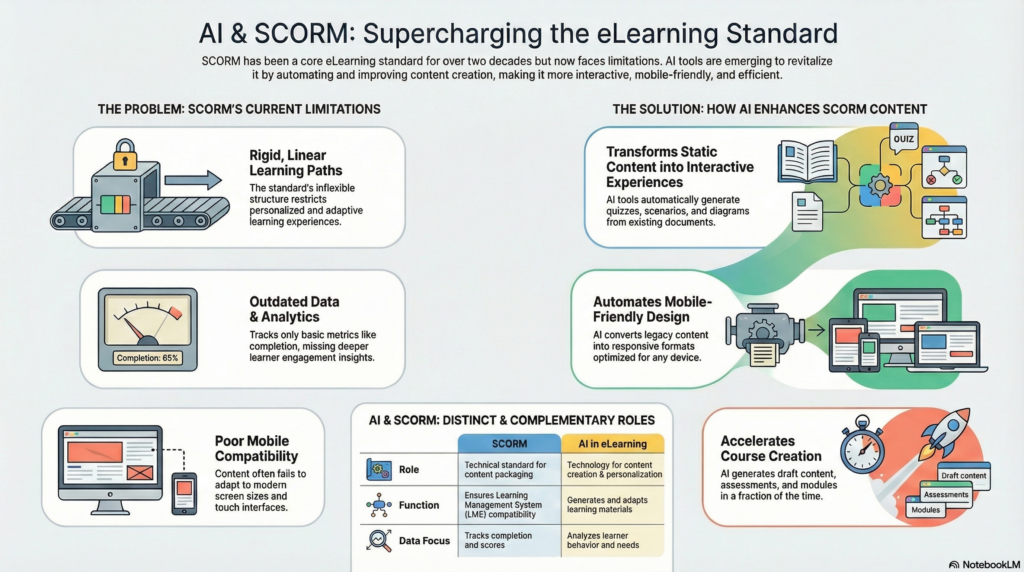
AI technology is expected to revolutionize instructional design workflows and the e-learning experience on several occasions. AI agents and generative tools are solving long-standing pain points for instructional designers and corporate training teams. They range from generating SCORM-compliant modules to scaling personalized training content.
Scorm’s Current Limitations At The End Of 2025
SCORM is still a popular choice for elearning content, but it shows its age in several critical areas. The standard struggles to advance modern learning experiences one expects in today’s digital world.
Technical Limitations
The SCORM communication protocol limits the data that can be tracked between content and an LMS. The standard mainly focuses on basic metrics such as completion status, time spent, and quiz score. It cannot effectively measure detailed learner interactions, emotional engagement, or sophisticated behavioral trends necessary for AI-driven analytics.

Limitations on Format of Contents.
Structured linear content delivery was the intent of the standard. Modern elearning courses are using adaptive learning paths, new personalization, and adaptive content creation. Due to SCORM’s architecture, achieving these features requires a lot of workarounds.
Key Limitations Include:
- Mobile compatibility issues with SCORM packages on various devices
- Limited support for social learning and collaborative features
- Inflexible content sequencing that restricts adaptive pathways
- Outdated data model that cannot capture rich analytics
- No native support for video streaming or interactive media formats
SCORM 1.2 or SCORM 2004 don’t have any built-in AI integration. The incorporation of generative AI, intelligent tutoring systems, or automated content creation into SCORM compliant courses is challenging for instructional designers. The rigid structure of the standard hinders effective communication between AI tools and the learning content. This compels developers to build custom solutions that likely compromise portability across different learning management systems.
Is Xapi Better Than Scorm?
Not true, as they have totally different functions and features. SCORM is a standard used in e-learning for packaging courses that can be uploaded. Xapi, also known as Experience API or Tin Can API, is designed to track a wider variety of learning experiences than those afforded by conventional modules.
It depends on specific training requirements as to which. SCORM is suitable for courses that learners solely complete within a learning management system. It helps you to track course completion, quiz scores, and time spent on training content.
Xapi records learning activities which are carried outside the LMS. Mobile learning, simulations, social learning, real-world performance, and so on. Xapi’s flexibility is helpful for organizations that track learning experiences from different sources.
Key Differences:
- SCORM: Works only within an LMS, tracks course-level data, limited to web-based content
- Xapi: Functions across platforms, records granular learning activities, supports offline learning
Standard authoring tools make it much easier to create and operate SCORM files. Most learning platforms out of the box support SCORM 1.2 and SCORM 2004. Xapi application creates an infrastructure complexity due to its need for a LRS to collect and store data.
Both standards are equally effective. SCORM is appropriate for traditional elearning courses and corporate training operating in a single LMS. XAPI resolves new age learning ecosystem issue where training content is available across systems. Numerous organizations employ both standards for monitoring distinct tracking requirements.
Will The Real Alternative To Scorm In 2026 Be Ai
AI is not replacing SCORM in 2026 since SCORM is the standard for packages and tracking eLearning content in learning management systems. The elearning ecosystem enjoys both functionalities which are quite different.
What AI offers is a way to enhance how organizations develop and deliver SCORM-compliant content. Tools powered by artificial intelligence can produce training materials in a shorter time frame than traditional methods. With these platforms, instructional designers can create modules, quizzes, and interactive elements that still package as SCORM 1.2 or SCORM 2004 files.
Key distinctions include:
| SCORM | AI in Elearning |
|---|---|
| Technical standard for content packaging | Technology for content creation and personalization |
| Ensures LMS compatibility | Generates and adapts learning materials |
| Tracks completion and scores | Analyzes learner behavior and needs |
The real change that will happen in 2026 is that AI will work with SCORM. Organizations employ AI tools to design courses that still have to interface with their LMS using standard protocols. While generative AI creates new content, SCORM content enables us to reuse existing content.
Some platforms are considering the use of xAPI and newer standards for more detailed tracking. Despite this, SCORM has been widely adopted in corporate training systems which will continue to be the main method of content delivery. The introduction of AI enhances what goes into those packages and how the learners interact with the content. But the need for them is still there.
Adding Interactivity To Static Materials Using Ai
Static PDFs, text documents, and slide presentations can be made interactive with AI-enabled tools. With existing content in hand, these platforms generate quizzes, knowledge checks and branching scenarios based on it automatically.
A COMPLETE STEP-BY-STEP CHEATSHEET
TO CREATING, LAUNCHING & GROWING A SUCCESSFUL MEMBERSHIP WEBSITE

Instructional designers may upload documents and leverage AI to develop clickable hotspots, interactive diagrams and embedded assessments. The technology scans static materials to identify key ideas and suggest engagement opportunities without manual coding and tech skills.
Common AI-driven interactivity features include:
- Automatic quiz generation from text content
- Conversion of images into interactive diagrams
- Creation of clickable navigation elements
- Generation of scenario-based decision points
- Addition of video content integration
SCORM compliance will no longer be a problem in using AI tools while they add these interactive elements. Through a static file, the authoring tool processes the learning objectives and generates the necessary module components to track learners in the LMS.
The platform can modify content difficulty according to learner’s response. If a learner struggles with certain ideas, the AI modifies later interactions to buttress those ideas. Through this adaptive method, personalized experience can be done without manually creating multiple versions.
Organizations use these capabilities to modernize outdated learning materials. AI content creation transforms dull corporate training documents into engaging elearning courses by adding interactive elements. Statically built solutions are replaced by tech solutions that reduce development time and improve learner metrics.
The Mobile Scorm Experience Is Generally Poor. Will Ai Change This?
SCORM content has not traditionally performed well on mobile devices. Learning to navigate with touch and to work with a design that reacts to the device. All of this was not part of SCORM specifications, made in the early 2000s.
There are major technical constraints. The fixed width layouts, Flash, and complex JavaScript in SCORM packages break on smaller screens. Mobile learners find it frustrating when they encounter content that requires pinching, zooming, or horizontal scrolling.
Common mobile SCORM problems include:
- Unresponsive layouts that don’t adapt to screen sizes
- Buttons and navigation elements too small for touch
- Video and multimedia components that fail to load
- Quiz interactions that don’t work properly on touch screens
- Slow loading times on cellular connections
AI-enabled authoring tools have now overcome this challenge by adapting content automatically. Mobile oriented, these platforms study SCORM packages to regenerate them. The AI detects what’s not working and proposes or enacts alternatives.
Modern AI tools can automatically convert legacy content into mobile-friendly formats while remaining SCORM compliant. Images are optimized, navigation is restructured for touch, and multimedia works on all equipment.
Adaptive modules can also be created through generative AI based on device detection. A single SCORM package can be authored to serve desktop and mobile learners without having to develop two packages.
The transformation occurs during the authoring stage whereby AI aids instructional designers to create inherently responsive content rather than post-development changes.
Frequently Asked Questions
Is AI changing how SCORM content is produced?
Indeed, the advent of artificial intelligence is transforming the way SCORM content is produced. This includes the development of AI-powered authoring tools allowing for faster creation processes, automation of repetitive tasks, and more. With the help of SCORM, instructional designers can produce interactive content faster while keeping it scorm compatible and meeting scorm standards. Also, the content object reference model helps create this.
How do ai-powered scorm authoring tools transform your SCORM course creation?
AI-driven SCORM authoring tools can analyze existing course content, make suggestions, auto-generate assessments and multimedia, and adjust layouts for SCORM courses. Tools like mindset ai and other ai-powered tools reduce content development time, help create content in multiple languages, and make it easier to transform your SCORM library into more engaging and effective e-learning content.
Can AI generate SCORM packages and keep them scorm compatible?
Yes — ai can generate SCORM packages that comply with scorm standards by assembling course content into the proper content object reference model structure and packaging assets so they are scorm compatible. Scorm integration can help generate manifests, trackable interactions, and metadata so newly generated content still supports scorm support and LMS reporting.
What is the impact of AI on instructional design and e-learning content?
The use of AI in instructional design facilitates the rapid prototyping of new ideas while allowing brand owners to create new, interactive content. With AI in instructional design, designers can focus on how learning will take place; AI-powered tools take care of formatting, localization, and content at scale. The focus then shifts from assembling manually to designing intelligently.
Will AI replace SCORM or what’s replacing SCORM?
SCORM is popular today, and the future of SCORM indicates tuning ai and SCORM integration and evolving to the latest and greater standards, like xAPI. The rise of ai is changing how scorm courses are produced rather than fully replacing scorm. During a Q&A session, a question was posed about SCORM’s future. According to Matthew, a hybrid approach where SCORM remains relevant while organizations adopt additional standards and AI-powered capabilities seems ideal.
How does AI help create more engaging and effective e-learning content?
AI can examine user data to suggest interactive elements. It can also generate multimedia items based on learner profile data. Through the use of ai for adapting content, creating branching scenarios, and optimizing assessments, SCORM-based and non-SCORM content is used by businesses for better learner outcomes and engagement.
Can AI adapt existing SCORM libraries and courses?
In fact, it is possible to modify an existing library of SCORM content to add new graphics or translate it into any language, make it more interactive and repackage a module into a new SCORM compliant format. With the help of this AI-based technology, businesses can deploy SCORM more easily and process older courses content on top of your SCORM catalog with minimal manual effort.
Are there limitations or risks with AI-produced SCORM content?
The quality may be variable (the ai bubble), metadata or assessment might not be accurate, the generated content may infringe copyright and not pedagogically sound. Despite AI speeding up the process of designing digital content in learning management systems, human oversight is still necessary to ensure compliance with learning objectives and SCORM standards.
What is the future of elearning content creation in the AI era?
Elearning content creation’s future will highly influenced by trending ai and more specifically, ai-powered tools that create content. Similarly, personalized learning paths, automated localization, and deeper analytics. The future of AI would be about collaboration between humans and AI. For example, designers will draft and prototype learning courses with the help of AI, which they will then improve through human intuition to create immersive SCORM-compliant experiences that can be scaled across organizations.
Final Thoughts
The convergence of AI and SCORM is a realistic evolution in elearning content creation. SCORM compliance helps to fulfill all the technical requirements that LMS needs for upload.
AI-driven creation tools manage routine instructional design tasks. They can generate quiz questions, customize module content, and create SCORM 1.2 or SCORM 2004 packages without coding. They can spend more time on learning strategy rather than technical implementation.
Key developments worth noting:
- Generative AI creates draft content that designers refine and validate
- Adaptive learning paths adjust based on learner performance data
- AI tools integrate directly with existing learning management systems
- Video content and interactive learning elements generate through AI assistance
Instructional designers can help make the use of the technology much smoother. Human expertise in understanding learner needs, corporate training objectives, and pedagogy cannot be replaced by AI agents. They tour as aides speeding up course design workflows.
SCORM – the dominant standard for elearning courses, despite new specifications. SCORM-compatible software makes an application shareable across various LMS systems. This practical consideration matters for organizations with existing LMS.
AI can help in developing learning programs in precise ways faster prototyping, maintained formatting, and quiz generation. As the AI models improve, platform capabilities will expand. Still it needs the intervention of humans to check the veracity and relevance.
The transition to AI-based authoring devices seems more sustainable than speculative. When appropriately applied, these systems will offer real value to organizations in need of efficient content creation.