Online Course 2026 Platform: Step-by-Step Guide to Creating and Selling Profitable Courses
Then, pick the right course platform and pricing strategy to fit your niche. When course creators don’t validate their ideas, they lose months building unwanted courses.
The blog guide to building a profitable course business walks you through the important steps including understanding student goals and structuring content. This process suggests which course platform with integrated tools you must choose, how to create impactful learning outcomes, and how to use email and communities to sell. Many creators forget important aspects such as accessibility and adapting their teacher style to learners.
Online constraints offered in 2026 will provide more opportunities for course creators to make money online in specialized course niches. The right course format, pricing and content structure can make your course creation success. Follow the best practices and avoid the mistakes. This step-by-step process helps creators, whether they are creating a first course or improving an existing course, to launch and sell their courses to use.
Starting With the End in Mind for Your Students
Learning experiences are often more effective when designed backwards from the desired outcomes. The process makes sure that every lesson and every activity connects to students’ achievements.
Course creators must decide learning outcomes before building course content. After the course, students will be able to do these things. Not just what the course covers.
Clear learning outcomes include:
- Specific skills students will master
- Measurable results they can demonstrate
- Real-world applications of the knowledge
- Transformation from starting point to end state
A course on email marketing might have the goal for students to launch their first campaign with a 20% open rate. A photography course may target students editing professional portraits. The content decisions are guided by these concrete endpoints.
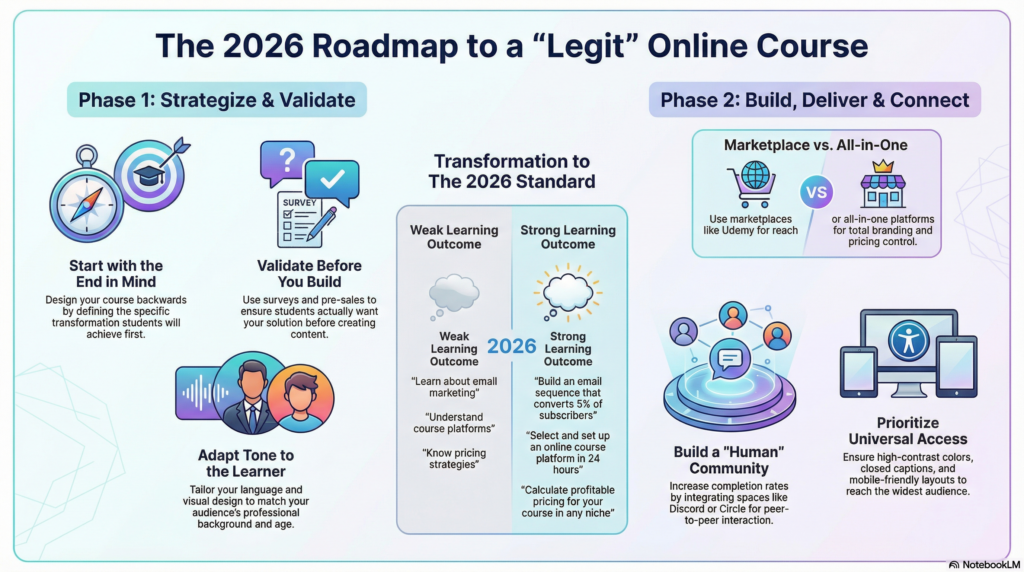
By asking potential students what results matter most, creators validate their end goals. Using Facebook groups as well as conversations, we will find out whether the expected outcomes match the market needs. It ensures that the course will not have skills students do not want.
The backward design process works in three steps:
- Define the end result students need
- Determine how to measure that achievement
- Create content that builds toward that goal
Every module must put the learners a step closer to the end goal. A simple table showing what skills each section trains lets course creators chart the progression.
Keeps course structure tight and purposeful. When students see that each lesson helps them become better, they stay engaged. It also makes pricing simpler as the value proposition remains clear and concise.
Really Understanding Your Students’ Goals and Objectives
Before creating their content, course creators must first identify what do their students want. Course design is driven by an understanding of students, from the structure of each module to the assignments.
Why Student Goals Matter
While creators validate their course idea they need to get to know student objectives. An excellent course solves real problems that learners are experiencing in their working or personal lives. Course Content (9 words): Without this clarity, course content often misses the mark.
Methods to Discover Student Goals
| Method | Purpose | Timing |
|---|---|---|
| Surveys | Gather quantitative data about objectives | Before course creation |
| Facebook Groups | Read discussions about common challenges | During validation phase |
| Email Marketing | Ask direct questions to existing audience | Throughout planning |
| One-on-one interviews | Understand deeper motivations | Early in process |
Course creators should identify trends in their responses. Good research brings out three to five recurring objectives.
Turn Course Goals into Content.
When objectives are clear, the creator can map them to modules or lessons. Every main objective becomes a milestone in the delivery format. The content guides learners toward these outcomes step-by-step.
The best online course platforms let creators check if their students achieve their goals. The feedback is used for courses’ improvement and to validate whether the topic of the original course was relevant to the learner’s needs.
A lot of creators miss this research phase and create in assumptions. This method hardly ever results in a profitable course business online as it does not actually solve any problems.
Adapt Tone, Language, and Design to Your Students’ Needs
The delivery method of content should match the expectations of the target audience. The Course for busy professionals needs a different language from one for creative hobbyists or technical specialists.
The tone should fit the learning skills and background of the learners.
Jargon-free explanations with more examples are need by beginners. Those who are advanced learners prefer a technical language that is brief because they are already aware of most things.
Key considerations for adaptation:
- Age group: Younger audiences may respond to informal language and fast-paced content, while older learners often prefer structured, detailed approaches
- Professional background: Corporate learners expect business-appropriate language and polished visuals
- Learning context: Students taking courses during commutes need mobile-friendly designs with shorter lessons
Visual design affects engagement and understanding. Course creators need to experiment with various formats to find what works for them.
| Student Type | Recommended Approach |
|---|---|
| Technical professionals | Direct language, detailed documentation, code examples |
| Creative learners | Visual examples, project-based learning, storytelling |
| Career changers | Step-by-step instructions, practical applications, encouragement |
The complexity of language for international audiences. When teaching global students, course creators should write with simple structure. Summaries or captions can be provided to enhance accessibility of this video.
A COMPLETE STEP-BY-STEP CHEATSHEET
TO CREATING, LAUNCHING & GROWING A SUCCESSFUL MEMBERSHIP WEBSITE

The design features of the course platform should not impede on the teaching style chosen by the instructor. Tools that make it easy to customize your platforms and templates to your own tastes or gritty images with images and styles.
Create Compelling Learning Outcomes
Learning outcomes are what a student will do at the end of a course. These statements can help in creating the content of the course and indicates the buyer what value they will get.
Course creators should write targeted and measureable outcomes that specify the skills and knowledge students will gain. Fuzzy claims like “know marketing” are less useful than concrete pledges like “create a targeted Facebook ad campaign with a $500 budget.”.
Effective learning outcomes follow this structure:
- Start with action verbs (create, analyze, design, implement)
- Specify the skill or knowledge being taught
- Include measurable results when possible
Poor results appear to be features or processes. Strong outcomes are about what students will be able to do after a course.
| Weak Learning Outcome | Strong Learning Outcome |
|---|---|
| Learn about email marketing | Build an email sequence that converts 5% of subscribers |
| Understand course platforms | Select and set up an online course platform in 24 hours |
| Know pricing strategies | Calculate profitable pricing for your course in any niche |
Top-selling courses typically feature three to five core learning outcomes on their sales pages. This number gives enough detail without overloading students.
Course creators can present their learning outcomes in a Facebook group or their email list for validation before building a complete course. If what you’ll learn creates interest and questions, it means people want the course.
Also helps in structuring the course content. Ensure that each module or lesson connects to at least one stated outcome of a course.
Choosing Your Online Course Platform
The most important decision that course creators must make while creating their course business is selecting the right platform. The platform dictates how creators deliver the course content, interact with learners, and sell courses.
Tools like course creation software handles everything from email marketing to payment processing. These solutions are great for creators who want a single system to manage their whole course business. These include video hosting, learner management, and sales funnels.
Standalone course builders are dedicated to course delivery and structure. The user of these stage requires one tool for payment processing and another for email. Using this approach offers more flexibility, but it requires maintaining different systems.
When evaluating platforms in 2026, creators should consider these factors:
- Course format support (video, text, quizzes, downloads)
- Pricing options (one-time, subscription, payment plans)
- Built-in marketing tools (email, landing pages, sales funnels)
- Payment processing fees
- Learner experience and interface
- Analytics and reporting features
A lot of course creators choose free plans to validate their course idea before buying a paid plan. According to the platform, creators are granted free tier access to record their course, structure the course and test it.
The best online course platform depends on the needs of the particular course business. Someone running multiple course niches with 1000s of learners has different needs than a creator selling step-by-step courses to small audiences. Selecting a platform must consider the course format, target audience and growth plans.
Build an Online Course Community
A busy community makes an ordinary online course feel like a workshop. Course creators who actively build communities for their courses enjoy higher course completion rates and increased student satisfaction.
Popular Community Platform Options:
| Platform | Best For | Key Features |
|---|---|---|
| Facebook Groups | General audiences | Familiar interface, built-in notifications |
| Discord | Tech-savvy learners | Real-time chat, voice channels |
| Circle | Professional courses | All-in-one community tools |
| Slack | Business topics | Organized channels, integrations |
Learners get a space to ask questions, share progress and connect in private communities. This peer interaction often provides more value than the course.
Right from the start, course creators must have community guidelines. These guidelines can help create an environment where members can participate without hesitation.
Effective Community Engagement Tactics:
- Host weekly Q&A sessions or live office hours
- Create dedicated channels for different course modules
- Encourage students to share their wins and challenges
- Recognize active members and highlight their contributions
- Share bonus resources and updates exclusively with community members
Built-in communities are now available on many course platforms. Standalone tools that integrate with your existing course builder may also be used by Creators. The essential thing is to select a platform where the audience already spends or feels comfortable joining.

Discussions are kept on track through active moderations. As your community grows, course creators can assign this responsibility to teaching assistants or willing students.
Ensure Accessibility and Inclusivity
Course content should cater to all learners. It should not be aimed at just one group. A course that is accessible helps in reaching larger audience and shows industry best practises
Essential accessibility features include:
- Closed captions or transcripts for all video content
- Alt text descriptions for images and graphics
- Screen reader-compatible course materials
- Keyboard navigation options for interactive elements
- High-contrast color schemes for readability
Many online course platforms now have built-in accessibility tools. Before selecting a course builder, check these must-have features.
The way the text is formatted is critical for accessibility. Make sure you use clear fonts, sufficient spacing, and styled headings. Do not put text over busy background images, and do not use colour alone.
Audio descriptions assist visually impaired students in comprehending visual course content. Allowing learners to download course content in various formats gives them greater flexibility.
Inclusivity considerations extend beyond technical features:
| Aspect | Implementation |
|---|---|
| Language | Use simple, jargon-free explanations |
| Examples | Include diverse perspectives and scenarios |
| Pricing | Offer payment plans or sliding scale options |
| Materials | Ensure cultural sensitivity in all content |
Course creators can test their materials with assistive technologies for accessibility. Achieving feedback from learners of different abilities helps identify the scope for improvement. One can use the free tools like WAVE and Lighthouse to assess the accessibility compliance of course content.
By adding this functionality when building the course, you save on costly reworking later on. Courses that are easy to access rank better in searches and are more highly rated by learners.
Frequently Asked Questions
How do I validate my idea before I build a course so people will pay?
First, you need to choose an audience and a profitable course topic. Talk to potential students, run surveys and create a simple lead magnet or free course to check interest. Landing pages, email opt-ins, and pre-sale offers help you test demand. If people pay during validation, you’ve proven the idea. Check pricing and features like one-on-one coaching or bonus modules early to know if you should build a full profitable online course or pivot before you make a course.
What is the best way to structure your course and outline your course content for completion?
Organize your course based on results: break down the full course into modules and lessons that guide learners step-by-step, from issue to solution. It is important to have a clear beginning, middle and end to your course: beginning (what the course will help people with), middle (core skills and frameworks), end (projects, assessments and next steps such as an advanced course or coaching upsell) Incorporate checkpoints, assignments templates, and action assignments to boost completion rates and make your course a good course.
Which platforms should I use: course marketplaces like Udemy or an all-in-one platform/online course builder?
It is based on objectives. Marketplace platforms such as Udemy offer you audience and discoverability but take cuts from your revenue and have control. Platforms like Teachable or all-in-one platforms featuring course creation tools and mobile app give you branding and pricing control, automation, and allow you to sell the course directly. Successful course creators use a hybrid method. They often launch their course on a marketplace to get feedback. The people behind online course builders and all-in-one platforms will move to their program for a successful online course business. With these, they can get better profits using features such as email, payment, and upsell funnel integrations.
How should I price my course in 2026 and what about 2026 pricing trends?
Value and outcomes form price rather than hours. Check what competitors are doing, get feedback on prices with an early bird offer, and look at tiered rates (self-study, group access, one-on-one coaching). By 2026, buyers will expect more personalization and bundles. When pricing your course, consider the outcome it delivers, what access to a community it provides, and features that would be enhanced by automation. Incorporate installment payments, annual subscriptions for continuous access, and upsell techniques if necessary to boost course sales and create a scalable online business.
What tools and automation should new course creators use to launch your course and manage course sales?
Employ a web-based platform for course development that blends with email marketing, monetary processors & analytics. To record your course, host video, quizzes and certificates, course creation tools are essential. Using machines to onboard, drip content, cart reminder, upsell funnels save you time and boosts conversions. Everything in a stack (or integration tools) helps you launch your course and scale course launches without manual work.
How do I improve your course after launch and turn feedback into a more profitable online course business?
Use surveys and track students’ progress through those direct messages to see where they have trouble or stop working through your course. Incorporate feedback to refine course content, supplement with new materials, or launch an advanced course. You can upsell your one-on-one coaching or group q and a. You can also iterate on your product by adding things like a mobile app or community space for your students. You may also run course launches or evergreen funnels to grow your sales. Marketing and regular improvement after course creation turns your course into a course business.
Final Thoughts
To create a successful online course in 2026, component strategy and consistent execution are the keys. According to this course creator advice, those who find the right platform, validate their ideas, and structure their content properly have the best chance of success.
The successful course businesses tackle specific problems for a narrow target audience. They don’t scramble to create course content before validating demand. They choose instead to validate their course topic through pre-sales, surveys, and discussions.
It’s important to select a platform but don’t let it delay action. Some creators find success with just basic tools, whereas others need an all-in-one solution with built-in marketing funnels. It is essential to match the platform with your business needs.
Essential elements for course success:
- Clear, step-by-step course structure
- Validated course idea with proven demand
- Appropriate pricing strategy for the target market
- Marketing plan including email and social channels
- System for collecting learner feedback
Creating a course is not a single event. “The finest course creators never cease to improve their creations and refine their methods.” They view their course business as an ongoing project rather than a finished product.
In 2026, acting will lead to success by sticking to best practices. Profitable course businesses are created by course creators who plan and implement strategies. There’s plenty of tools and platforms available to support creators at any level, including those new to the field; as well as those who are established experts launching a new course.