Best LMS Platforms For Training Success In 2025
Organizations need an efficient way to deliver effective corporate training. This is why learning management systems have become essential tools Companies can make use of this cloud-based tools to design, manage and track the learning experience for their employees.
The expanding global LMS market shows the growing demand for a centralized learning platform that benefits businesses for employee training and upskilling them.
Organizations now want systems that provide personal learning paths, social collaboration features, and thorough analytics for measuring training impact.
A learning management system, or LMS, refers to digital learning software that helps save costs. Most user-friendly LMS offer features such a mobile access, integration, and reporting tools to show a clear return on training investment.
Learning Management System International Market Is Growing
The global learning management system market is growing steadily in several regions. A new study shows growth driven by digital transformation each year.
Key Growth Drivers:
- Remote workforce expansion
- Corporate training digitization
- Cloud-based platform adoption
- Mobile learning accessibility
Companies across the globe put money in LMS platforms. More and more companies are becoming aware of how less expensive a digital learning solution is compared to traditional classroom training.
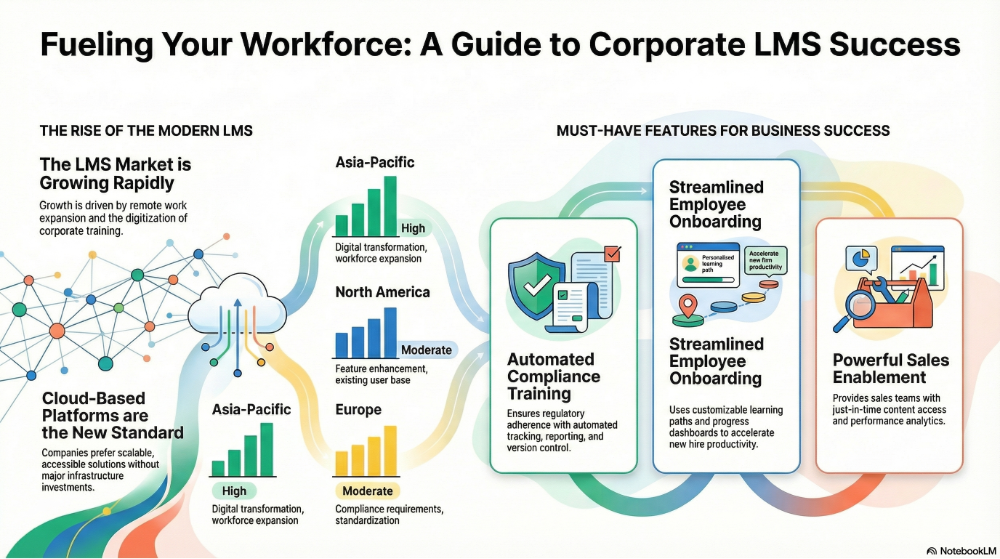
The Asia-Pacific region is experiencing especially rapid growth. India, China and other South East Asian countries are opting for Cloud-based learning management systems to fulfill their corporate training needs.
North America and Europe hold a huge share of the market and growing moderately. These existing markets specialize in advanced functionalities such as personalized learning experiences and social learning.
| Region | Growth Rate | Key Factors |
|---|---|---|
| Asia-Pacific | High | Digital transformation, workforce expansion |
| North America | Moderate | Feature enhancement, existing user base |
| Europe | Moderate | Compliance requirements, standardization |
| Latin America | Growing | Cost reduction, remote learning adoption |
Small and medium enterprises are opting for affordable LMS solutions. By using learning technology that has minimal infrastructure costs, these companies can repeat their successes more easily.
Corporate learning management systems can be integrated into existing business applications. This integration ability encourages businesses to use the software.
Educational institutions also promote the growth of the market through implementation of online learning platforms. Universities and training providers are extending their digital learning offerings to a larger student population.
What The Key Things That LMS Need To Have For Your Organization
The organization needs these LMS capabilities to fulfill essential business functions. What are some awesome solutions offered by Armstrong to drive immediate business results?
Compliance Training
For an LMS to be effective, it should oversee compliance automatically, tracking the progress and certificate of employees. The system should produce comprehensive reports outlining completion rates, expiration dates, and audit trails for regulatory compliance.
Administrators can automatically enroll employees for the mandatory course assignment based on their roles. Automated reminders should be sent for approaching deadlines or overdue training requirements.
The platform should implement version control for training materials to guarantee that employees use the most up-to-date compliance information. The system needs to archive old contents and deploy new materials when regulations change.
When a business hires a new employee, compliance courses will be automatically assigned to them. The LMS must also allow compliance with SOX, HIPAA, or other industry standards.
Employee Onboarding
A strong onboarding module should have customizable learning paths for various roles and departments. New Employees must have a clear path through orientation materials, company policies, and job training.
Managers can use progress-tracking dashboards to track new hires through onboarding requirements. The system should indicate bottlenecks where workers make mistakes or take too long.
The LMS must allow for the delivery of multimedia content, document libraries and interactive modules. New hires can complete onboarding tasks from any mobile device in any location.
New workers get linked up with mentors, forums, and other workers with social learning features. These tools speed up cultural integration as well as lessen time-to-productivity.
Sales Enablement
Sales teams need content right when they need it. They should have mobile-friendly access to product info, competitive data, and customer success stories. The LMS should arrange all materials according to product lines, customer segments and sales stages.
Measurement of improvement in sales through training content. Managers need to see how individuals and teams are progressing toward skill development in various competency areas.
The platform must offer certification for product knowledge, selling, and customer interaction. Testing and re-testing done automatically keeps the sales reps up to date.
Content collaboration tools allow sales teams to exchange positive practices, customer suggestions, and market data. The LMS should promote knowledge transfer from experienced sales people to new ones through a systematic mentoring program.
Some Of The Best Learning Management Systems
From iSpring Learn and TalentLMS as easy-to-use LMS software to the enterprise-grade Absorb LMS, there are lots of platforms in the LMS market today. Open-source options like Moodle are customizable, while LearnWorlds and LearnDash are tailored for specific business requirements.
iSpring Learn
iSpring Learn is an LMS intended for corporate training, hosted on the cloud. The platform is SCORM, xAPI and AICC content compliant, meaning it works with practically all e-learning authoring tools.
Key Features:
- Mobile-responsive design with offline content access
- Built-in video conferencing and webinar capabilities
- Advanced reporting with detailed learning analytics
- Integration with popular business tools like Salesforce and Zapier
This system allows registrations and certifications to track automatically. Users can make learning paths and assign compulsory training programs. iSpring Learn allows organizations to personalize the interface with white-label branding and elements.
The platform has social learning features discussion forums, and peer-to-peer messaging. Administrators can control user access based on their role, and manage many branches from a single dashboard.
LifterLMS
This is a plugin for WordPress which makes a learning management website. The system is for the entrepreneurs and educators creating online courses and memberships.
Core Capabilities:
- Drag-and-drop course builder with multimedia support
- Built-in payment processing and subscription management
- Gamification elements including badges and certificates
- Advanced quiz and assessment tools with multiple question types
The platform delivers drip-fed content and has prerequisite courses. LifterLMS works well with popular WordPress themes. Users can offer tiered membership levels and allow free or paid course access.
A COMPLETE STEP-BY-STEP CHEATSHEET
TO CREATING, LAUNCHING & GROWING A SUCCESSFUL MEMBERSHIP WEBSITE

The system monitors student progress and engagement. It is possible to text and announce whatever you want to the students. LifterLMS has lots of ways for you to customize every aspect of your site through add-ons and third-party integrations.
TalentLMS
TalentLMS is a learning management system that lets businesses manage their own online courses. The system is easy to use and can be implemented quickly without technical expertise.
Notable Features:
- Multi-language support with automatic content translation
- Mobile apps for iOS and Android devices
- E-commerce functionality for selling courses
- Branch management for multi-location organizations
You can get started with pre-built course templates and content libraries. TalentLMS includes video-conferencing software like Zoom and BigBlueButton. Users can personalize the interface with unique company logos and colors.
It includes tracking the progress of the learners and completions. System automatically sends notifications and reminders for course deadlines. TalentLMS connects to widely used business apps like Salesforce, Shopify, and Google Workspace.
Moodle LMS
An open-source learning program utilized globally by colleges and companies is Moodle. Due to its plugin ecosystem and modular design, the platform offers extensive customization.
Technical Specifications:
- Self-hosted or cloud-hosted deployment options
- Support for unlimited users and courses
- Multi-language interface with community translations
- Extensive API for third-party integrations
The system consists of advanced evaluation instruments that include anti-plagiarism tools. Moodle has tools for collaborative learning such as wikis and forums. User role and permission customisation by admins here.
The platform provides full-scale gradebook functionality and learning analytics. Thousands of plugins and themes are contributed by developers for Moodle. Organizations may customize codes with no license limitations to fit their needs.
Absorb LMS
Absorb LMS provides organizations with great potential to streamline the training process through enterprise-grade functioning. The system focus on scale and better admin controls.
Enterprise Features:
- AI-powered content recommendations and learning paths
- Advanced reporting with custom dashboard creation
- Single sign-on (SSO) integration with enterprise systems
- Compliance tracking and audit trail capabilities
System supports blended learning with online and instructor-led training. The Absorb LMS can automatically add or remove users. The platform has social learning and peer collaboration capabilities.
A mobile app can provide offline content and push notifications. The software works with Microsoft Teams and Slack other common business solutions. Dedicated customer success managers are present for enterprise clients at Absorb LMS.
LearnWorlds
LearnWorlds aims to deliver best-in-class user experiences through interactive video capabilities and social learning features. The site is for course makers, training organisations and schools.
Interactive Elements:
- Video interaction tools with clickable hotspots and overlays
- Built-in social community features and user-generated content
- Advanced course builder with multimedia support
- White-label mobile app creation
You can now sell your courses online using the system. With LearnWorlds, you can monitor your students’ activity and video views. Users can create a certificate and digital badge for course completion.
Support live sessions and integrate webinars. You can add SCORM compliant content with LearnWorlds. The system has tools for affiliate marketing and promoting courses for creators.
LearnDash
LearnDash is a plugin for WordPress LMS systems that helps in making and selling courses. Educational institutions, corporations and individual course creators can use WordPress sites to set up this platform.
Advanced Functionality:
- Focus mode for distraction-free learning experiences
- Advanced quiz builder with multiple question types and logic
- Course prerequisites and drip-fed content scheduling
- Integration with popular WordPress themes and plugins
The system supports group management and instructor roles. Exam Track can help monitor students’ progress. You can upload assignments and receive feedback from instructors on the platform.
The insights provided by ProPanel analytics show learner behaviour and how the course is performing. LearnDash works with the biggest payment processing and membership plugins. The system supports multilingual content and layout of RTL languages.
Frequently Asked Questions
What makes the best LMS for training providers?
The ideal LMS for training providers seamlessly integrates reliable training management, content management, and reporting with features such as cloud-based lms deployment, compatibility with online training courses, personalized learning journeys, and tools that enable impactful learning. The software is ideally designed for collaborative learning. It has strong analytics to measure the ROI of learning. In addition, it should enable integration with your business systems.
How do I choose between a corporate LMS and a learning experience platform (LXP)?
Corporate LMS platforms emphasize the management of onboarding, compliance training, and structured learning paths whereas a learning experience platform focuses on user personalization, discovery, ai-based learning recommendations and informal learning. Many organizations use LMS and LXP together to take care of the corporate learning needs and deliver learning in the flow; companies must choose between one based on more rigid compliance workflows or engagement.
Are cloud-based LMS platforms better for training providers?
Providers of online training and online training courses are increasingly using cloud LMS platforms that offer scalability, lower upfront costs, and easier maintenance. They enable learning on the go, fast changing of the learning content, mostly include integrations for partner training and customer training. For business solutions, check for security, multi-tenancy and custom branding.
Can an LMS handle both customer training and employee training and development?
Yes. A flexible training platform enables the simultaneous hosting of customer training, partner training, and internal employee training and development to take place via segmented portals, role-based access and tailored learning paths. Tools like lms for customer training as well as content management and reporting dashboards help providers deliver customized programs while measuring engagement as well as business impact across audiences.
What role does AI play in modern learning management software?
Artificial intelligence increases the ability to recommend content. It automates personalisation for learning journeys. It supports adaptive assessments. It helps surface relevant learning in the flow of work. By personalising online training courses and recommending next steps, learning and ai can boost engagement and measurable impact. Improving the effectiveness of your training software will increase the roi of your learning initiatives.
How important are integrations and content management when selecting an LMS?
Integrations and content management are critical. A good LMS needs to support SCORM/xAPI and video streaming. In addition, it needs to have authoring tool connectors. Also, single sign-on (SSO) is required along with CRM/LMS integrations. All of this will enable seamless enrolments and reporting. With powerful content management, quickly update training courses, reuse modules in your programs, and provide a consistent learning experience, whether corporate learning, customer training or partner training.
Should I try an LMS before committing? Are free trials useful?
Yes. A free trial for onboarding software lets you check the software for key workflows. These include things like delivering courses, metal access (learning on the go), analytics, and how easily the admin can use it. Use the trial to test your fit for your education and training needs, verify that the platform supports your lms options, and see if it can deliver impactful learning at scale.
How does an LMS support onboarding, compliance, and measuring ROI?
An LMS that works well will create automated learning paths to support your onboarding. It will track compliance and include reporting and certification features. It will also be able to give you analytics to measure learning outcomes against business KPIs. Find tools that connect training engagement with performance metrics so you can prove the return on investment of learning and keep improving courses and delivery.
What are the top learning management systems and how does Adobe Learning Manager compare?
With so many options available, how do you know which learning management system to choose? Corporate learning management systems only go so far or perhaps customer training or an ai-powered learning platform is better suited for you? Adobe Learning Manager is a high-grade enterprise provider that is famous for having great learning content management, integrations, and scalable cloud-based lms capabilities. When looking at best options, you will want to compare pricing, ease of use, support for different learning formats, lms for customer training features, and the flexibility to enable engaging, personalized learning journeys.
Final Thoughts
Training at scale has become imperative for modern organizations. Learning management systems have become important infrastructures to cater to these needs.
CMS is the new sunny face of learning and development. Remote teams require training solutions that are available across devices and locations.
Key considerations when selecting an LMS include.
• Most important factors include: integration with existing systems, scalability for growth, user experience for admins and learners, analytics and reporting, mobile access for more workers on the go.
When using LMS solutions, first focus on learning objectives of the company. Technology serves the learning strategy, not the reverse.
The rates of engagement can be enhanced using personalised learning paths and social learning features. These capabilities enable organizations to move past cookie-cutter training methods.
Investing in strong learning management system reduces training costs and improves employees efficiencies and effectiveness. Organizations that focus on learning gain competition in rapid changing markets.
It is implementation and support that makes it a success. Training administrators require adequate resources to optimize the use of the platforms.
The LMS market continues to evolve thanks to advances in artificial intelligence and robotic learning. Organizations must choose platforms that can grow with their needs while remaining focused on core learning outcomes.