Managing members, donors, and volunteers across different platforms is challenging for nonprofits.

The right membership management software helps streamline your operations, strengthen your community, and free up more of your time for your mission. Acquiring software that fits an organization’s specific needs and budget can transform a nonprofit’s operations.
There are several membership management software choices in the market with different features, pricing, and capabilities.
Certain platforms are better for tracking donors than for coordinating events, or scheduling volunteers.
By understanding the difference nonprofits can make better decisions with technology.
Explore what makes some membership software more effective than a database tool, and which ones are best in 2026.
Essential functions of effective software, why donor and membership management gets confused, and how getting it right can help organizations of all sizes.
What Membership Management Software Is Right for Your Nonprofit?
Different Organizations have different specific needs so it depends on them which membership management software to choose.
For small nonprofits with basic needs, software that tracks member information and processes renewals may suffice.
Integrated solutions are needed by bigger organizations that handle fundraising, event management, and volunteer coordination.
Organizations should look at their existing workflows before comparing software options .
This assessment tells us what is essential, and what is optional.
Key factors to consider include:
- Budget constraints – Monthly or annual subscription costs, implementation fees, and training expenses
- Member database size – Capacity limits and scalability as the organization grows
- Integration requirements – Compatibility with existing accounting software, email platforms, and payment processors
- User accessibility – Number of staff members who need access and their technical skill levels
- Reporting capabilities – Data analysis tools for tracking membership trends and engagement
In the cloud, you can access them from places too.
On-premise solutions offer greater control over data security, but internal IT resources are needed.
Nonprofits must ask for demos from several players and involve staff who will use the software regularly.

Testing out the interface and responsiveness of support during trial periods may uncover problems.
Non-membership-based nonprofits and donor-focused organizations have different needs when it comes to member management.
Some software can handle recurring member dues and benefits tracking, while others manage donor relationship and campaign tracking.
Differences Between Donor Management vs. Membership Management
Many Nonprofits equate donor management to membership management opposite is true they are different systems.
The focus of donor management is on contributions, donation history and financial relationships.
Membership management oversees managing relationships with members, their renewals, benefits and activities.
Fundraising functions take precedence in donor management software.
It monitors the amounts of gifts made as well as pledge campaigns and the correspondence with donors.
The program creates tax receipts and monitors giving patterns to find top givers.
Membership management systems are designed for recurring relationships.
The program gets information out of members, processing membership dues through bank accounts, and member directory management.
The system tracks uses of benefits, participation in events and engagement
| Feature | Donor Management | Membership Management |
|---|---|---|
| Primary Focus | One-time or irregular contributions | Recurring memberships and renewals |
| Key Metrics | Donation amounts, campaign ROI | Retention rates, member engagement |
| Communication | Appeals and thank-you letters | Renewal notices and member updates |
| Financial Tracking | Tax receipts and gift processing | Membership dues and payment schedules |
Some nonprofit organisations need both.
Organizations with formal membership structures benefit from special membership tools.
Strong donor tracking is essential for those raising funds.
Many modern platforms provide both functions in a single.
Through this integration, nonprofits can see complete supporter profiles.
Staff members can monitor whether a member also contributes financially or whether a donor might become a member.
The organization’s requirements will determine the right choice.
Membership-focused features should prioritize members’ issues.
Nonprofits that depend on donations need strong donor management capabilities.
Key Problems Membership Management Software Can Solve for Nonprofits
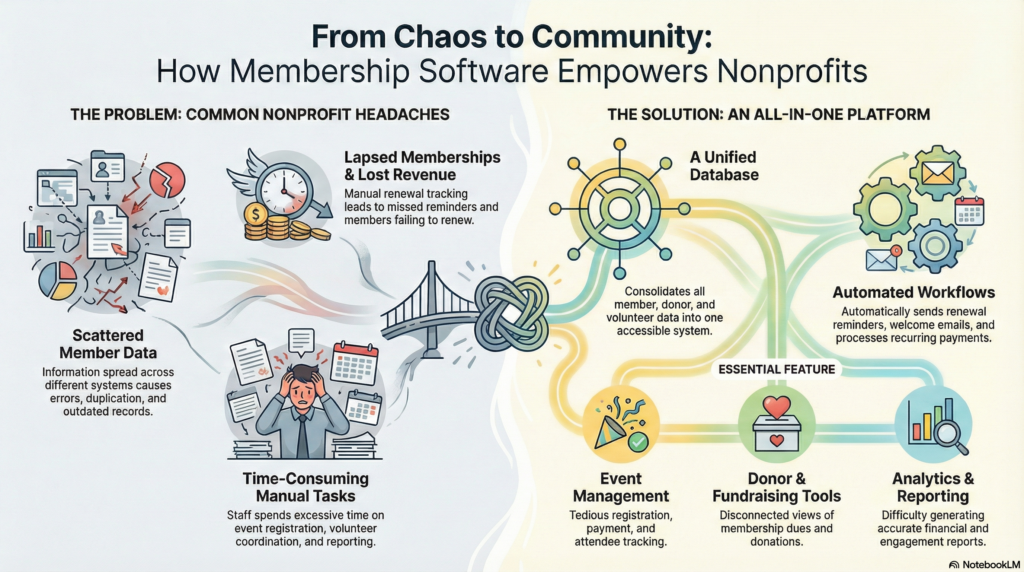
Nonprofits struggle to manage member data across spreadsheets and disconnected systems.
When information is processed manually errors will take place. Further, there will be duplication of records. Also, the information might get outdated which can affect effective communication.
A membership management software merges data and resources in a single database for all members.
A COMPLETE STEP-BY-STEP CHEATSHEET
TO CREATING, LAUNCHING & GROWING A SUCCESSFUL MEMBERSHIP WEBSITE

This negates the need for staff to pull donation history, event attendance, or volunteer participation from a variety of sources.
Tracking renewal becomes a challenge for nonprofits that are using a manual process.
Memberships can lapse while renewals are lost due to lack of timely reminders to members.
Notices and payments that are automated reduce the burden of administration.
When organizations don’t use segmentation, communication gaps are created.
The software allows you to send messages that are tailored according to membership type, engagement level or giving history.
Basic tools hinder nonprofits when reporting their finances.
Membership platforms connect to accounting apps, giving you a consolidated view of dues, donations, and event fees.
This helps deliver accurate financials for board and compliance reporting.
Managing an event without the right tools for registration, payment and attendance tracking becomes a tedious job.
Using online registration forms and confirmation emails from a proper platform simplifies and eases these processes that are often faced manually.
When organizations cannot see what volunteers are available, qualified for, or have done before, coordination becomes much more difficult.
Management software keep volunteer profiles, schedules, and other information to make it easy to match them with the right opportunity. It also helps management to keep a record of volunteer contributions.
Membership Software Is More Than Just an Admin Tool
Membership management software do more than just manage the administrative tasks. They can also be strategically beneficial to nonprofits.
These kind of platforms take care of many operational needs through a single system that drives member engagement and organizational growth.
Today’s membership software delivers one central database for donor management, events, and volunteer tracking.
This connection breaks down data silos and minimizes the time staff spends switching between tools.
Organizations can examine member activity across channels to create a complete picture of engagement.
Key capabilities include:
- Automated renewal reminders and payment processing
- Member communication through email campaigns and newsletters
- Reporting tools for tracking retention rates and engagement metrics
- Online member directories and self-service portals
- Integration with accounting software and fundraising platforms
The relationship management features built into membership platforms help nonprofits understand their members better.
Staff can segment members by interests, donation history, or participation levels.
This data enables targeted communication that resonates with specific member groups.
Financial management tools within membership software streamline revenue tracking from dues, donations, and events.
The software automatically records transactions and generates financial reports.
These features reduce manual data entry and improve accuracy for accounting purposes.
For small nonprofits, membership management platforms offer enterprise-level functionality at accessible price points.
Many software options scale with organizational growth, adding features as needs expand.
Build a Magnetic Community from a Strong Foundation
Accidentally, strong nonprofit communities don’t just happen
For success, these things require careful planning, the right equipment, and insight into members.
Membership management software acts as the foundation for engaged communities.
These platforms manage member data and activities in a central location while automating previously time-consuming tasks.
When organizations select appropriate software solutions, they establish systems that grow with community growth.
Essential elements for community foundation:
- Centralized database that stores complete member profiles and engagement history
- Communication tools for personalized outreach and mass messaging
- Event management capabilities to organize gatherings and track attendance
- Payment processing for dues, donations, and event registrations
- Volunteer management features to coordinate and recognize contributors
When small nonprofits select the right platform, they can get the most benefit.
Software that is designed for associations will usually include member portals where members can find resources, update their information, and connect with others.
With this self-service approach, the administrative burden is reduced, along with member satisfaction.
Strong technical infrastructure can directly enhance community engagement.
Nonprofit CRM solutions empower organizations to segment membership, identify member participation patterns, and deliver key content.
Financial management and accounting software integration allows for smoother transactions and transparency.
There’s more to community magnetism than software tools.
Nonprofit teams can concentrate on relationships rather than administration through them.
When staff spend more time on member engagement and less time on data entry, communities become stronger.
Key Features to Look for in Nonprofit Membership Software
Choosing software for managing memberships, it is key to evaluate certain capabilities that influence operations and member engagement.
A combination of a database, communication tools, payment processor and automation for nonprofit fits the bill.
Website Builder
A built-in website builder reduces costs on web development solutions while offering a seamless member experience.
The feature should provide customizable templates for nonprofits to showcase their mission, programs, and membership benefits without requiring technical knowledge.
Seamless integration between the website and membership database allows for instant updates when members join, renew or update their country of residence.
This link cuts down on hand-operated data input and limits blunders across the board.
To access the website, members use a different mobile device.
The builder should provide responsive layouts for smartphones and tablets, along with forms for membership, donations, and events that function properly.
Membership Database
The membership database is the main place to keep all member information such as contact details, level, renew and engage.
A solid system can allow for unlimited custom fields to capture the data your organization needs, such as volunteer skills, committee participation, program interest, etc.
Staff can immediately segment members by search and filtering functions that include membership status, past donations, or event attendance.
Household management becomes easier with advanced databases that interlink family members without interfering with individuals.
Protect your members with secure data features like encryptions, frequent back up, and more.
The database should comply with data protection standards and easily generate audit trails tracking who has accessed or amended records.
Membership Forms
Membership forms that can be customized streamline the application and renewal process by collecting important information in a single step.
The forms should feature conditional logic, allowing fields to be displayed or hidden per member responses for lesser complexity.
Key form capabilities include:
- Multi-page layouts for longer applications
- Payment integration for immediate processing
- File uploads for required documents
- Electronic signatures for waivers or agreements
- Auto-fill functionality for returning members
The software should allow unlimited forms for any type of membership, volunteer application or registration.
Members can use mobile-optimized forms to submit from anywhere.
Email Marketing and Messaging
Nonprofits can constantly connect with members through customized email campaigns with communication tools.
A drag-and-drop email builder providing templates for newsletters, event invitations, renewal reminders and announcements should be inbuilt in the platform.
Segmentation features enable organizations to send on-target messaging to specific member groups depending on interests, activity level, or membership tier.
Tokens allow you to insert the member name, renewal date and other custom fields.
Email marketing sequences allow you to send out the standard welcome email to new members or scheduled renewal reminders.
Tracking of opens, clicks, and conversions helps gauge campaign efficacy.
Membership Directory
Online membership directories enable members to connect and strengthen the community.
The settings of the online directory should allow members to configure their secrecy settings which means to allow public to use any information that the users create. It should also allow members to choose which members can see their profile on-site.
Members can find one another by location, profession, interests, or other criteria.
Organizations can have personalized areas for board members, committees, or other groups within membership.
The link between the directory and the membership database should run automatically so information does not need to be updated manually.
Profile pages can include profile photos, bio texts, links to social media, and any custom fields relevant to that organization’s community.
Members-Only Portal
Through the secure portal, members have access to resources, documents, and benefits that justify your membership.
Users should be able to access downloads, videos, articles and discounts only available to members.
Members can update their profile, check payment history, register for activities, manage communications preferences and more without the intervention of any staff.
It will lessen administrative burden further and allow member’s immediate access to information.
A member can access the portal using credentials from other platforms using single sign-on (SSO).
The portal should be password-protected and have a session timeout for security, but user-friendly.
Donor & Fundraising Tools
This solution unifies your membership and fundraising efforts in a single system. The software should track donation history and produce tax receipts, as well as recurring gift and membership dues.
Campaign management empowers organizations to run fundraising campaigns with dedicated donation pages, campaign progress, and peer-to-peer fundraising features.
It is necessary for the donor profiles to have sections on giving history, engagement score, and relationship notes for the purpose of stewardship.
Tools for acknowledgment automate thank-you emails and receipts with personalized options for major donors.
Reporting functions which analyze giving patterns, identify lapsed donors, calculate donor retention rates and more.
Event Management
Comprehensive event tools handle registration, ticketing, and attendee management within the same platform as membership data.
Organizations can create events with multiple ticket types, early bird pricing, member discounts, and capacity limits.
Registration forms collect attendee information and sync data directly to member profiles.
Check-in features streamline on-site registration through mobile apps or QR code scanning.
Event capabilities should include:
- Waitlist management for sold-out events
- Session scheduling for multi-track conferences
- Name badge printing and customization
- Post-event surveys and feedback collection
- Financial reporting for event revenue and expenses
Flexible Payment Processing Options
Payment processing must support various transaction types including one-time payments, recurring billing, and installment plans.
The system should accept major credit cards, ACH transfers, digital wallets, and potentially checks or cash with manual recording.
PCI compliance and secure payment gateways protect member financial information during transactions.
Transparent fee structures help organizations understand processing costs and choose the most economical options.
Automated payment features handle recurring membership renewals and sustaining donations without manual intervention.
Failed payment notifications alert staff and members to expired cards or insufficient funds, with options for automatic retry attempts.
Automation & Analytics
Workflow automation reduces repetitive tasks by triggering actions based on specific conditions or time periods.
Common automations include membership renewal reminders, welcome sequences for new members, and birthday acknowledgments.
The software should allow organizations to create custom workflows without coding, using visual builders to connect triggers and actions.
Automated tasks can update member records, assign tags, send notifications, or create follow-up activities.
Analytics dashboards provide real-time visibility into membership metrics like growth rate, retention percentage, and revenue trends.
Customizable reports generate insights on member engagement, event attendance, and fundraising performance to inform strategic decisions.
Support & Onboarding
Quality support resources help organizations implement and maintain the software effectively.
Vendor support should include multiple channels such as phone, email, live chat, and knowledge base documentation.
Onboarding services accelerate implementation through data migration assistance, system configuration, and staff training.
Dedicated onboarding specialists guide organizations through setup phases and best practices for their specific needs.
Ongoing support options vary by vendor and plan level.
Organizations should evaluate response
Best Membership Management Software Solutions in 2026
Organizations managing memberships need platforms that streamline operations while supporting growth.
The following solutions offer distinct capabilities ranging from learning management integration to comprehensive CRM functionality for nonprofits and associations of various sizes.
LifterLMS
LifterLMS specializes in membership sites built on WordPress, combining course creation with membership management.
The platform enables organizations to deliver educational content while controlling access through membership tiers and subscription models.
The software includes features for drip content scheduling, quiz creation, and achievement certificates.
Organizations can sell courses individually or bundle them into membership packages with recurring payment options.
Key features include:
- Custom membership level creation
- Integration with major payment gateways
- Email marketing automation
- Detailed student progress tracking
- Add-on marketplace for extended functionality
WildApricot
WildApricot targets small to mid-sized membership organizations with an all-in-one platform.
The software handles membership databases, event registration, payment processing, and website management without requiring technical expertise.
Members access a self-service portal where they update contact information, renew memberships, and register for events.
Administrators create custom membership levels with different pricing structures and renewal schedules.
The platform includes automated email communications for renewals, event confirmations, and member engagement.
Financial reporting tracks revenue by membership type, event income, and donation sources.
Core capabilities:
- Mobile-responsive membership directory
- Online event registration with payment collection
- Automated renewal reminders
- Member-only website areas
- Integration with QuickBooks and Mailchimp
LearnDash
LearnDash transforms WordPress sites into learning platforms with integrated membership management.
The software focuses on course delivery while providing membership restrictions and monetization options.
Organizations create multi-tiered course structures with lessons, topics, quizzes, and assignments.
The membership component restricts content based on subscription status or one-time purchases.
Advanced features include dynamic content delivery, prerequisite settings, and drip-feed scheduling.
The platform supports certificates and badges for course completion.
Notable features:
- Focus mode for distraction-free learning
- Group management for corporate training
- ProPanel reporting dashboard
- Video progression tracking
- Multiple payment gateway support
MemberClicks
MemberClicks provides membership management specifically designed for associations and chambers of commerce.
The platform combines member databases, event management, communication tools, and committee tracking.
The software automates membership workflows including applications, renewals, and lapses.
Custom member types accommodate individual memberships, corporate accounts, and tiered structures with different benefits.
Primary functions:
| Function | Description |
|---|---|
| Member Portal | Self-service access for profile updates and renewals |
| Event Management | Registration, payments, and attendance tracking |
| Committee Management | Volunteer coordination and role assignments |
| Email Marketing | Segmented communications and automated campaigns |
| Reporting | Membership trends, revenue analysis, and engagement metrics |
MemberClicks includes a website builder with member-only content areas and integration capabilities with accounting software.
The platform scales for growing associations while maintaining user-friendly interfaces for staff and members.
Fluent Community
Fluent Community is a WordPress plugin that allows you to create a private community with membership functionality.
Member interaction is encouraged, through discussion forums, direct messaging, and an activity feed.
Businesses create branded communities where people interact around shared interests or work-related topics.
Access to various community spaces, courses or resources is restricted based on membership levels.
The software enhances popular WordPress plugins to extend their use for accepting payments and sending emails.
Users can have profiles and be notified of new content.
Available features:
- Private and public community spaces
- Topic-based discussion forums
- Member directory with custom profiles
- Activity streams and notifications
- Integration with membership and LMS plugins
Neon CRM
Neon CRM provides robust constituent relationship management for nonprofits with membership programs.
The system provides one database for everything from membership tracking to donor and volunteer management.
Member and donor and volunteer are all the same constituent record.
For every contact, organizations keep a record of their membership history, donations, events, and hours volunteered.
The membership module processes applications and renewals automatically
Membership types can be customized for individuals, families, and organizations at flexible prices and benefits.
Integrated capabilities:
- Fundraising campaign management
- Online donation forms with recurring options
- Event registration and check-in
- Volunteer shift scheduling
- Email marketing and segmentation
- Financial reporting and accounting integration
The report tools of Neon CRM helps in saying membership retention rates, revenue trends and engagement levels.
The platform is suitable for small nonprofits and mature organizations managing thousands of constituents across multiple programs.
Frequently Asked Questions
What is membership management software and why is it important for nonprofits in 2026?
Membership management software manages the records, renewals, payments, communication and community of the associations and nonprofits. It is a management solution. Nonprofits in 2026 need the right software which streamlines management tasks, improves donor management and fundraising workflow, integrates with your fundraising software and donor management software, and allows nonprofits to focus on more mission-driven work. Selecting the best nonprofit software or membership solution ensures that your nonprofit can scale and meet evolving nonprofit needs.
How do I choose the best membership management tools specifically for nonprofits?
Start by writing a list of why you think your nonprofit needs a membership size, donor management, task reporting and budget. Search for software options that have tools built for nonprofits like recurring billing, event registration, volunteer tracking, CRM integration. Choose from top nonprofit software solutions for 2026 with user-friendly membership interface and fundraising software integration for your scale. Applications from our guide on the best membership management software, which include the top apps from numerous0954974 charitable organizations.
Are there good membership software options for small nonprofits and associations?
Certainly. Small nonprofits can purchase budget-friendly, user-friendly membership software that is built specifically for nonprofits. Try to find a management system which is easy to implement, has essential membership management features which allow subscription management and communication, and grows with you. Open-source choices, such as CiviCRM, are a solid choice. CiviCRM is an open-source membership solution that many civic and small nonprofits use. Commercial options tend to offer hosted support and easier onboarding.
What software features should nonprofits look for in a membership management solution?
Essential features of the software will include a member database, renewals and receipts automation, payment processing, event and volunteer management, task management, reporting and analytics, email and community management, along with fundraising and donor management integration. Check out mobile access, security and customizing of membership dashboards. Finding the right software for nonprofits is possible with effective membership management features that let you create streamlined workflows and help reduce administrative burden.
How do associations and nonprofits compare when selecting an association management software or membership solution?
Nonprofits usually place a high priority on fundraising, donor stewardship, and program reporting. In contrast, associations often require advanced certification tracking, tiered memberships, and chapter management. With the rise of nonprofit software solutions for 2026, association management software is currently focusing on community management and complex membership rules. Finding the best for your organization means you must map your management tasks, compare the top nonprofit software and membership tools and test platforms. Most vendors offer demos so that nonprofits can see how the software can help before buying. Nonprofits that use Bloomerang CRM are impressed with its strong donor management features whereas other platforms do better at association-specific workflows.
Final Thoughts
When it comes to the membership software, you need to determine what exactly you want, and then what is possible after considering your budget and the needs of your non-profit.
Organizations should focus on relevant features that will assist both their current operations and future growth.
Key considerations include:
- Database capabilities for member information
- Donor and fundraising tools
- Event management functionality
- Financial tracking and reporting
- Integration with existing systems
Small organisations prefer simple systems that can manage important membership functions without unnecessary sophistication.
Typically, big organizations required robust solutions that include improved volunteer management and better relationship tracking.
The software marketplace for nonprofits is expanding more than ever in 2026, and this gives organizations more options at different price points.
Companies should sample different platforms free trials before signing a decadelong solution.
This hands-on method shows which interface works best for staff and volunteers.
While budget is important, the lowest price isn’t always cheapest.
Investing a little bit more in full-suite software can shorten administrative hours and retain more members.
Now cloud-based, mobile, supported options are available through most top membership management platforms.
These standard features enable ease of remote work as well as flexibility of distributed teams.
A good software solution creates a new workflow, eliminates manual data entry and provides reporting tools that help organisations gain insights.
The organizations that devote time to appropriate implementation and training their staff get better long-term results from their platform.